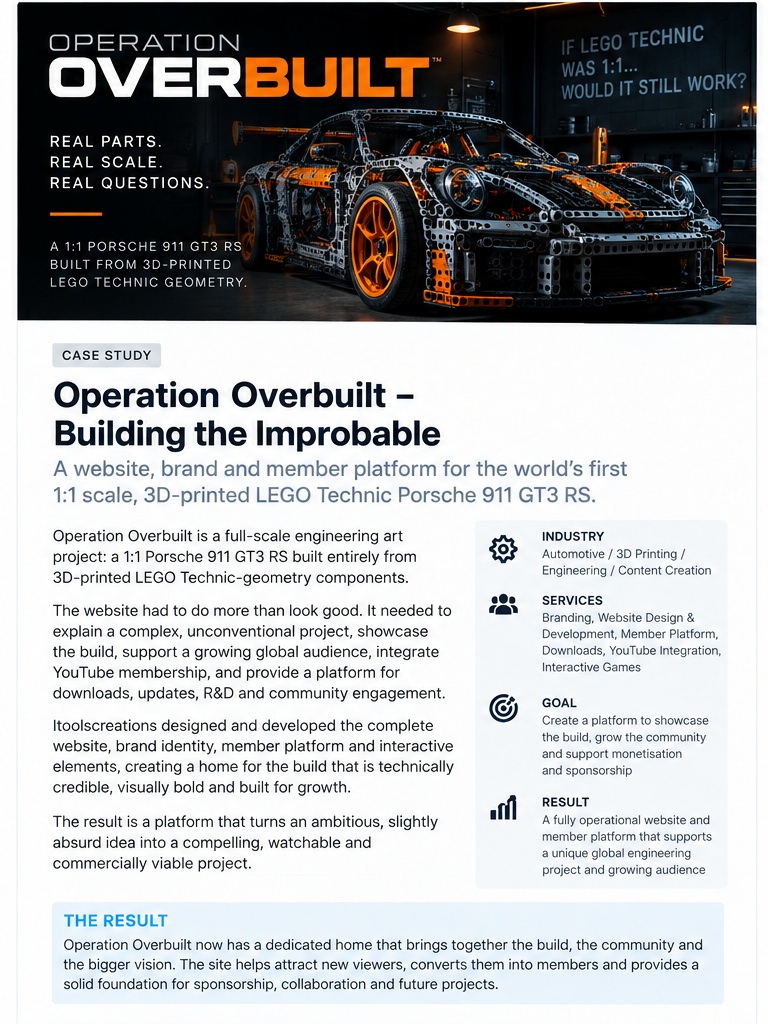
Engineering a website around a project that refuses to fit a normal category
Operation Overbuilt started with a deliberately unreasonable engineering question: if LEGO Technic geometry is scaled all the way to 1:1, will it still work?
The project is a full-scale Porsche 911 GT3 RS inspired build made from 3D-printed Technic-geometry components. That immediately created a website problem. A normal portfolio site was too small for it, a conventional creator website felt too generic, and a purely technical project database would miss the personality that makes the build worth following.
The website therefore had to do several jobs at once. It needed to explain the build clearly, document engineering development honestly, give members more depth, create credible routes for sponsors and supporters, and leave enough room for future projects that may have nothing to do with cars.
Designing the site around the way the project actually develops
The structure was built around the real programme rather than around a generic website template.
The Build area carries the main 1:1 project. The R&D Lab provides a home for experiments, workshop observations, design changes and development work. Future Ideas gives emerging concepts somewhere to live before they become full projects, while the Members area creates a deeper layer for people supporting the build.
That separation matters because Operation Overbuilt is not simply a finished product being presented after the fact. It is a live engineering programme where failures, revisions and breakthroughs are part of the story.
The visual language follows the same logic. Dark technical surfaces, cyan and orange signalling, oversized engineering typography and mission-control style interfaces make the site feel connected to the workshop rather than detached from it.
More than a project website
A major part of the work was making the website useful behind the scenes as well as interesting from the outside.
Member access is connected to Google and YouTube sign-in so eligible supporters can reach protected content without creating a completely separate membership identity.
Member-only downloads, workshop releases and digital files are delivered through protected routes rather than ordinary public media links. That allows the project to release STL, 3MF, PDF, image and video content while keeping access tied to the member system.
The R&D and Future Ideas sections also give the project somewhere to document development properly. Informal workshop findings can be shown honestly without being presented as calibrated engineering test results when no calibrated testing has taken place.
Interactive experiences such as Bunker Breach and Robot Rumble extend the project identity beyond static pages. Both are browser-based games built into the wider Operation Overbuilt world, with score systems, mobile layouts and member continuation.
Building the commercial routes without turning the site into an advert
Operation Overbuilt already sits at the intersection of consumer 3D printing, mechanical design, fabrication, motorsport, creator media and automotive culture. The website needed to make that commercial potential visible without making the project feel like a sponsor deck wearing a website costume.
YouTube, shop, funding, partner and member routes are therefore integrated around the project rather than stacked on top of it. A visitor can understand the build first, then decide whether they want to watch, support, join, buy or explore further.
The same structure gives future sponsors somewhere credible to understand the project, the audience and the wider engineering context without interrupting the public experience.
Built for whatever comes after Build 001
The most important design decision was not to make the website about one car forever.
Build 001 is the flagship, but Operation Overbuilt is a wider platform for unusual engineering, 3D printing, fabrication, robotics, experiments and ideas that are interesting enough to deserve a real attempt.
The site was therefore structured so future builds can sit alongside the GT3 RS without weakening the original story. New engineering programmes, robots, research projects and experimental machines can be added using the same visual and content system.
The finished platform feels much closer to the project behind it: ambitious, modular, slightly over-engineered and built around finding out what happens when an improbable idea meets reality.