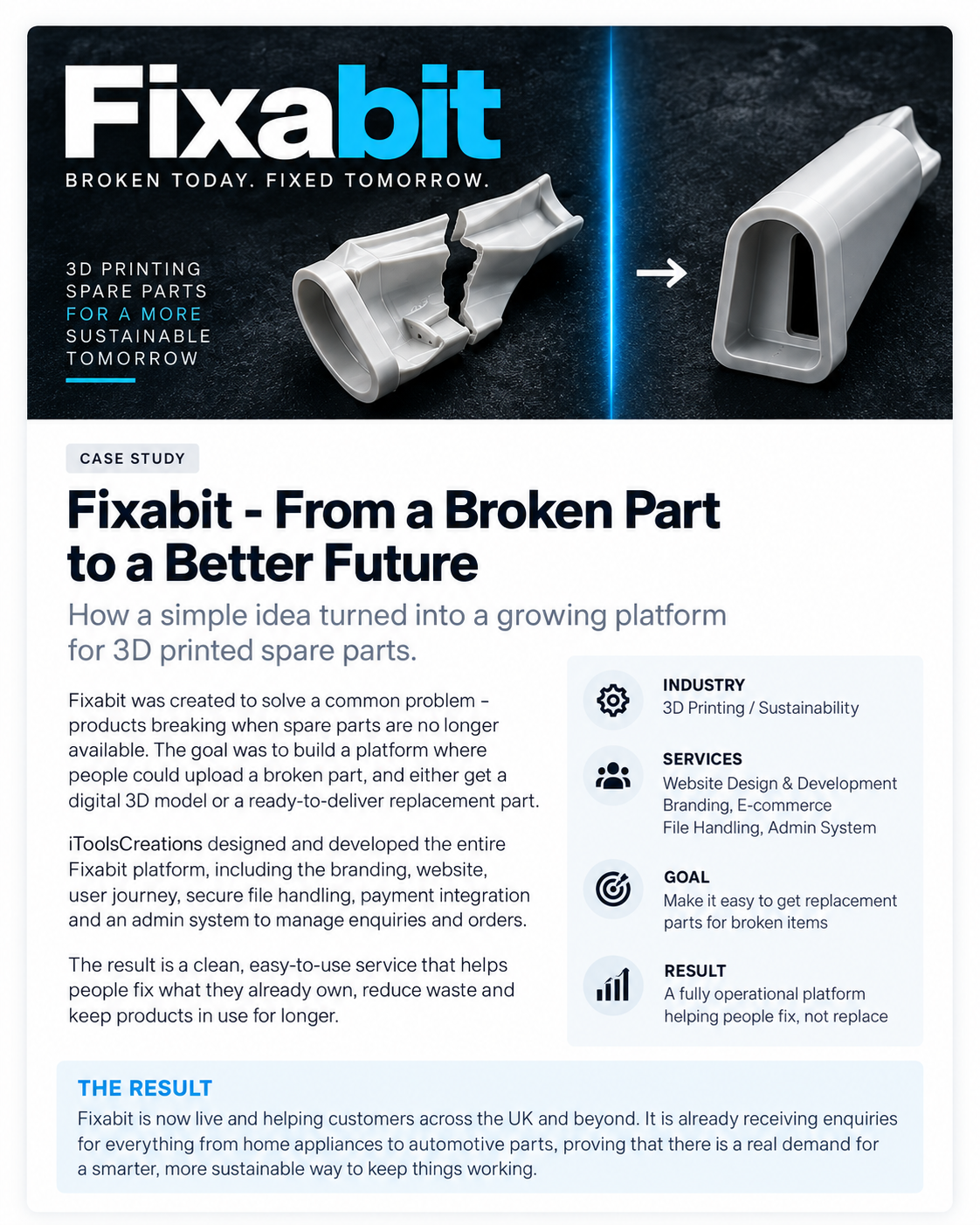
Turning an engineering capability into a simple consumer proposition
Fixabit started with a very ordinary problem.
A small plastic clip breaks. A bracket disappears. A gear is discontinued. The manufacturer no longer supports the product and suddenly the only official answer is to replace the whole thing.
The engineering answer may be straightforward. The customer experience usually is not.
Fixabit was created to bridge that gap.
The brand proposition was deliberately kept simple:
Fix a bit. Save the whole thing.
Instead of presenting customers with a list of manufacturing technologies, the website begins with the problem they already understand: the part is broken, missing, obsolete or unavailable.
From there, Fixabit can assess whether the best route is to source the part, recreate it, redesign it or manufacture a replacement.
Building a brand that feels engineered, not homemade
The Fixabit identity was developed around a black, warm off-white and acid-lime colour palette.
The visual language combines technical drawing references, grid layouts, dimension lines, CAD-style geometry and bold industrial typography.
The main FIX A BIT logo was designed to work as both a full brand mark and a compact social-media identity, while supporting graphics were created for LinkedIn, promotional material and digital advertising.
The aim was to make Fixabit feel accessible without making it look lightweight.
It is still an engineering service, but one designed to make sense to someone who may never have heard of reverse engineering, CAD modelling or additive manufacturing.
A request system instead of a generic contact form
The website was built around a dedicated part-request workflow.
Customers can describe the problem, identify the product or model, provide measurements and upload photographs of the broken or missing component.
Each submission generates its own Fixabit reference number so the enquiry can be tracked properly from the beginning.
The system allows the customer to choose whether they are interested in a digital file, a finished replacement part or simply want Fixabit to assess the best route.
Uploaded photographs are kept private rather than being exposed through the public WordPress media library, and admin-only download controls were built into the request-management process.
Customer acknowledgements and internal notification emails use the same reference number, keeping communication tied to the original request.
Rate limiting, privacy controls and background anti-spam measures were also built into the submission process without placing visible CAPTCHA barriers in front of genuine users.
Keeping the message focused
One of the most important decisions was what not to put on the website.
Fixabit is not positioned as a generic 3D-printing service.
The customer does not need to know which machine, material or manufacturing process will eventually be used before submitting the problem.
They just need to know that the part they cannot buy may still have another route.
That keeps the service focused on the outcome:
Broken. Missing. Obsolete. Unavailable.
Show Fixabit the problem, and the engineering work begins from there.
The finished platform combines branding, web design, technical workflow and manufacturing capability into a service that can be understood in a few seconds.
Tiny part. Big irritation. Much better problem to solve than replacing the whole product.